sábado, 1 de noviembre de 2014

Inscriptions on a wall

I got used to blogging in English and maybe to thinking in English too. I am thinking of ending this blog some time soon anyways, but until that happens, I will keep posting in English.
That said, I´m not gonna say that it´s been a long time since my last entry like I always do.
So let´s get it started.

I have wanted to write about this for more than a month now. You know I don´t give a fuck about patriotism, especially when it´s related to the great USA. But for some reason (which I know but am not gonna share) one thing in Columbus made me cry inside, and maybe a little bit outside too. The thing in question was these walls in Ohio Veterans Plaza:


I didn´t know what they were when I first saw them. They are two walls, in both borders of the plaza, showing inscriptions which are real transcriptions from letters that US soldiers sent to their loved ones while fighting in any of the multiple wars the US have been involved in.
Yes, this probably intends to enhace the american spirit of a united nation that I dislike (and despise) so much (paradoxical, I know, since I want to move there). But, forgetting about that, these are letters written by men who knew they would probably not come back to their people alive. And when I read what they wrote to their wives or girlfriends (or kids) I kind of felt (it´s taking me a good while to find the word) let´s say jealous/lonely/relieved. In a way, I envied those women who had someone who loved them until the last breath, whose last words were love words for them. Lonely, I don´t need to explain why. Relieved, same thing.
But I (stupid girly me) couldn´t help imagining I was one of those women, and wondering whether I would want that or not. Whether I would rather have and lose a love like that, or never experience it. And I don´t know the answer to that question yet, but for now I will take option A.

So I want to share some of the pictures I took of those inscriptions. That will be it. Bye for now.


jueves, 18 de septiembre de 2014

Spanish stereotypes and Tordesillas' Meadow Bull

Like every year, the Spanish village of Tordesillas "celebrated" yesterday the festivity known as El Toro de la Vega (The Meadow Bull), which consists, as wikipedia well points, of slaughtering a bull by people on horseback or on foot.
Groups defending animal rights protest against this brutality year after year without success.
And here's my view.
As usual, it's always about the two Spains. And for this purpose, we could divide Spanish young society in two main groups: the toffs and the perroflautas.
According to the stereotype, the Spanish toff is typically a middle/upper class kid who studied business or economic sciences in a private university, votes for PP, wears sunglasses and hair cream (and pearl earrings, as big as possible, if it's a female) and goes to clubs to dance like crazy, drink long drinks like crazy and if so, takes drugs in the form of pills.
The Spanish perroflauta, as opposed to the toff, studied social sciences or journalism in a public university, votes for lefty or republican parties, wears clothes as colorful and wasted as possible and green/blue/pink dyed hair, has multiple piercings and tattoos, and gather with friends to drink beer and smoke marijuana sitting on the floor in a public square -where he pees when needed.
The perroflauta will protest in favor of free abortion, euthanasia, public services and female rights. The perroflauta might have worked as a volunteer helping immigrants in the coasts of Cadiz, or cleaning the petrol spilt in the coasts of Galicia (whereas the toff volunteered to receive the teenage pilgrims who came to Spain for the World Youth Day).
In their condition of perroflautas, these guys also protest for animal rights and, in this case, against the meadow bull. Problem? Society doesn't see them as people concerned by the brutality committed against the bull, but as young and miscarried trouble makers who have nothing better to do with their time.
Even myself, being my ideas much closer to those of the perroflautas, tend to consider them this way sometimes...
You'll get my point when you see the photos in this article:
(Click here to see the article)

For the record, I want to make it clear that I'm talking about "stereotypes". I don't mean to offend anybody... Only those who support the festivity!!

I would like to end this post with a funny anecdote... My friend Miky writes a blog where, from time to time, he posts about wikipedia sabotage. Of course, they have moderators to censor the fake facts from the articles, and they act rather quickly, so I had never seen one live... until today!! When I found this:


There's a fake line in spanish next to the photo, under the title "Torneo del Toro de la Vega".
Translation: "Nonsense consisting of slaughtering a bull with lances, which some idiot murderers find funny and they support it. A whole country against this tradition which, mayor after mayor, all completely retarded, no one has the balls to abolish."
(And yes, for possible spanish-speaking readers, the last tab reveals I had no idea how to get a screen shot with a Mac...)


jueves, 11 de septiembre de 2014

Reflections on S11

13 years ago now, televisions all around the world interrupted their programs to show a plane crashing against one of the towers. I remember I was at home, watching the news while having lunch -it was lunch time in Spain- when the anchor announced this last minute news about a horrible flight accident. Then we all saw live the second plane.
When I first visited NY last year I had a lot of time to go sightseeing by myself. Not only in the US but in general, I'm not attracted by these "glory to the brave who gave their lives for their homeland"-kind monuments, and I visited the WTC only after I had seen every other main touristic attraction I could think of. Once I got there, I saw I had to pay if I wanted to visit the memorial, so I decided to pass. I wandered around, not really knowing where to go next, when I accidentally found St Paul's chapel. I hesitated for a moment, but as I was already there...
Patriotism is one thing I will never understand, and about that, the land of the free and home of the brave knows quite a bit. Religious -or any other kind of- fanaticism is another one. Actually I guess patriotism could be considered as another form of fanaticism.
Anyways. I saw the churchyard first. Despite it, I still entered the chapel, not knowing what I would find. And what I found was a few improvised altars showing personal objects that belonged to the victims, along with firefighter helmets, army medals and decorations and so on. At the very entrance, at the right, a bed and a piece of paper on the wall explaining that volunteers took turns to sleep there during the rescue works. Everywhere, photographs of the victims, many of them young people smiling in their graduation ceremony, or dressed in their firefighter uniforms holding a little child on their arms, or simply posing with their families. And all around the place, short letters, postcards and post-its reading "God bless America", "Always in our hearts" or "We will never forget" type of notes.
As I was walking around the place, I passed by a few groups of proud americans.
Do you know how I say sometimes a shabby drawing can inspire me more than the finest work of art? It was kind of the same thing here. It was like if I had entered some grey space, completely unexpectedly, I didn't know how to feel. Those americans had it very clear, they felt proud of their country. I mostly felt awful, awful and ashamed of the human stupidity and blindness.
Don't get me wrong. If I were american, I'd probably feel proud. Even being spanish, even being politically atheistic, even not being part of this wonderful community of brave and free people, I absolutely think that all those volunteers, dead and alive, deserve my admiration and my credit for what they did, had their reasons been patriotic or simply humanitarian.
But I cannot share that feeling of hate and revenge, of America vs the world that some people seem to have. As I said, I felt terribly awful and all I could think of was the blindness of the human race. Just like I feel when my fellow talks about getting a kalashnikov to go kill russians in the name of Ukraine, or when he says I can't compare the Soviet Union to the spanish civil war, because we only count 500000 killed against their millions.
We tend to organize in groups. Geographical, political, religious, racial. And we defend our members against the others, just because they belong to our group. We don't seem to fucking understand that we are all alone here, and equally alone. That we all have the same feelings, the same needs, the same fears. If you allow me, that by the 8th week of intrauterine life we all have our body parts equally formed, that from a unicellular organism we all end up being human bodies, with our arms and legs and head, and our heart in our left chest and our liver in our right abdomen, and we don't develop wings, peaks, tails, scales or hoofs (but even if we did). That we'll all have the same end. That our lives are rivers ending in the sea of death... And therefore, that we should help individuals fight situations, instead of groups fight groups. Even more when what makes us belong to a particular group -geographical, political, religious, racial- is some artificial distinction that in most cases (even political and religious) has not been chosen, but imposed to us. So watching those americans share that feeling of "together against islam for the memory of our dead" only contributed to my general feeling of shame.
The same when I read this kind of idiocy in the bbc news: "The bell tolls, the national anthem is sung but always it is sound of relatives reading the names of lost love ones that lingers longest in the autumn air."
I guess someone should explain the writer a few things about physics... Or that might just be me, but I don't see the necessity of getting sentimental when it's supposed to be an objective article.

Connecting with these ideas, I can't help talking (again) about african immigration into Spain, and the fucking brutal fence.
Frontiers aren't but artificial lines drawn arbitrarily to separate the political units we call countries. Now, to all those who protest against immigration, we should wonder what we did to earn the land we live in. Personally, I don't think I have done much. I have never worked the land, I have never built my house, I have never planted fruit trees, I don't even recycle most of the times. And if I had ever done any of these things, it wouldn't have been because I am more worthy than others, but because I was allowed to be there and do it. And if my ancestors (assuming they lived in what we call Spain, which I don't even know) had done anything, I don't think I can attribute that merit to myself.

Anyways, I just wanted to write a few lines with the occasion of the anniversary...

I will still say one last thing. On March 11th 2004, more 200 people were killed in Madrid in several train bombings. From the beginning, Al Qaeda was said to be responsible. My mother works as a primary school teacher, and she always has a lot of immigrant students in her class. By that year, she had a muslim girl whose mom was the typical muslim veiled woman who didn't speak a word of Spanish. The day of the bombings, when the woman came to pick up his girl from school, she approached my mother, crying under her veil, and hugged her. That's what I mean by individuals.

miércoles, 27 de agosto de 2014

Here the aliens

As you probably know, I finished reading The war of the worlds a few days ago. Just like it happened to me when I finished A brave new world or Animal Farm, I thought it´s awesome how a book written by the end of the nineteenth century can still be so valid today. I mean, you can well read and enjoy many classics, but with these ones, you could even think they have been written only a few decades ago...
Anyway, this is mostly my impression. I enjoyed reading, even if the story is not thrilling and is kind of slow. And I also liked the "poof!-type" ending.

I would like to share a short text here. I don´t know if you know, but sometimes my favorite part of a book is not the most brilliant one, but the one that makes me think the most, especially about things that are not closely related to the story... The part that makes my mind maunder to philosophical matters and such. I think that´s also why I like paintings such as Richter´s Tote, not because of the esthetics of it in itself.

Ok, here it goes.

All these--the sort of people that lived in these houses, and all those damn little clerks that used to live down that way--they'd be no good. They haven't any spirit in them--no proud dreams and no proud lusts; and a man who hasn't one or the other--Lord! What is he but funk and precautions? They just used to skedaddle off to work--I've seen hundreds of 'em, bit of breakfast in hand, running wild and shining to catch their little season-ticket train, for fear they'd get dismissed if they didn't; working at businesses they were afraid to take the trouble to understand; skedaddling back for fear they wouldn't be in time for dinner; keeping indoors after dinner for fear of the back streets, and sleeping with the wives they married, not because they wanted them, but because they had a bit of money that would make for safety in their one little miserable skedaddle through the world. Lives insured and a bit invested for fear of accidents. And on Sundays--fear of the hereafter. As if hell was built for rabbits! Well, the Martians will just be a godsend to these.

I will probably get philosophical here very soon... I have a lot of things whirling in my mind these days. But this is it for today.

[Suggested readings (other than, of course, A brave new world and Animal Farm):
Childhood´s End by Arthur C. Clarke
From the Earth to the Moon by J. Verne (I will have to get this one)]

jueves, 21 de agosto de 2014

And what about aliens?

It´s been so long again. I have wanted to write about many things these days, but my mind was somewhere else (it still is, actually) and I wasn´t too motivated.
I wanted to write about (in order of appearance in my mind along the days) Coetzee and Foe, my new residency, ebola, african immigration to spain, spain, relativeness (I don´t think that exists as a word in spanish either, at least not with this meaning of "everything being relative"), unfinished stories and aliens.

About my new residency I will just say, I don´t know how it will end up being, but right now I´m so happy with the choice I made: I like what I do, I´m getting to know great people and I think I can be quite good at it (with time and effort, of course).

About ebola and immigration, not today.

About spain, not a great place to live but definitely an awesome place to visit, I will write some other day.

About relativeness, here it goes:
When I worked with oncology patients I used to think I was so lucky to be healthy. I used to think about those unfortunate people I was trying to help, some times succeeding, some others not so much. Some of them died, some of them lived, a few got cured. Many of them were even younger than I was. But then, as they say, while there´s still life, there´s still hope.
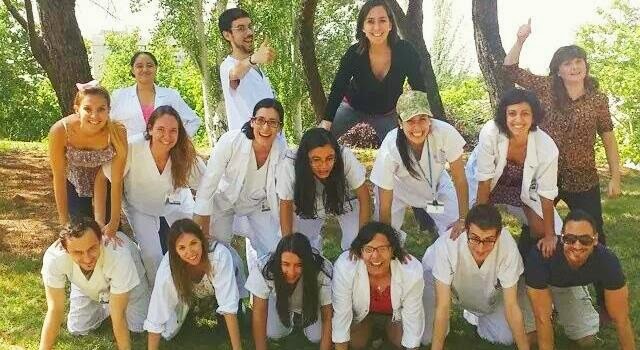
What I´m seeing now is what comes next: they are already dead. We get these bodies that were real people just a few hours ago, people with hopes that turned out to be useless. People we don´t know, people we have not treated, people we don´t care about. People who, by the moment we put our hands on them, are just inanimate things. We cut them, open their bodies, slice them. (Yes, the happy group of people you just saw in the photo, we do that). And then we learn about the medical tragedy behind each case. I mean, they wouldn´t demand an autopsy if it was an expected death of a long time sick patient.
And then you think, no matter how bad things are, I´m not that person on the autopsy table, not even a relative of his/hers. I´m not a grieving mom whose dead fetus is being sliced to be later stored in a plastic container. And there´s no guarantee that I won´t be there, it could just happen any day. You might think it´s macabre, but it actually helps. And I develop a whole philosophical theory every time I go down there.

Changing subject, I know I have to write about Coetzee´s Foe, but I don´t have the book right now and there were a few lines I wanted to transcribe, so that will come later, soon.
So about unfinished stories now. This goes in relation to this book I read a few months ago, Atmospheric disturbances, which I really liked. I have already posted about it, but I published it without saying a word about this. It´s not that the story in the book is unfinished, and I don´t want to spoil it. But it was something I thought about as I was approaching the last pages. And I guess this is also, and again, a reflection about happiness. We always hope to get this "happily ever after" ending, and most of the times we don´t realise that such thing just doesn´t exist. That after the movie ends, after that last love kiss they show us on the screen, the characters will still have to cope with their everyday lives. The happy ending won´t last, because it´s not an ending. Unless the characters die at that very instant, which, on the other hand, would not exactly be happy (though it would definitely be "ever after"). So, what I mean is, we all aspire to happiness, but all we´ll get is, at most and if we´re lucky, a few happy instants that will only last in our memories, and I don´t think we can ever be satisfied with our lives if we don´t keep that in mind, if we keep hoping and suffering for an imaginary happiness that we´ll never reach, not as a final condition. We all survive the best way we can.
That, or I´m particularly gloomy these days.

lunes, 21 de julio de 2014

Understanding the conflict...

I tried to do some little digging about it, to make myself an opinion mostly, but I found that, as it usually happens, sources are clearly biased and they pick sides, just like media does. So after a while of alternatively reading that ones or the others are the good and the bad guys for this and that, I´m sharing with you the most reliable information I could find. Hope it helps you to understand!


miércoles, 2 de julio de 2014

Time must have a stop

I finished Time must have a stop, by Aldous Huxley, a few days ago.

As usually, I tried to find a link to the book review... but in this case, I couldn´t find one I liked.

Will explain:
All of them talk about what happens in the book, the characters, the story of Sebastian Barnac and his summer in Italy. All of them (and also the cover of the edition I got) tell us how uncle Eustace shows him the pleasures of life, and how Bruno Rontini teaches him about spirituality instead.
Ok yes, that is what happens (in broad strokes, at least), but that is not what the story is about! Huxley didn´t write that book to tell us about a stupid teenager´s summer in Italy. What matters here is not what happens. The whole story is just an excuse to introduce the characters, and the characters are, each one of them, a representative of one particular ideology. This way, Sebastian´s father stands for politics (passionate politics, rather); uncle Eustace, for the joyful life (sex, art, vice) free of consequences; Bruno Rontini, for spiritualilty and insight; and Sebastian is the young guy who cares only about himself and actually believes himself to be the center of the universe, and who measures the importance of every fact in relation to the consequences it will have for him. This is only the main characters, then we have others who, not being so "main", also play their parts in the snapshot of society Huxley makes.
And, until you get that (until he exposes at least a few of the main characters), the book is boring as hell. After all, why should you care about a stupid selfish egotist (english) kid?

I bought the book because the cover said it was Huxley´s favourite among all his novels (and also, because the first lines are quite similar to something I read in one of García Márquez´s short stories and I wanted to compare the resemblance! -- I still have to). And I think the reason why it´s his fave is because he uses the characters as he pleases. He uses them to defend his own arguments over others, and at the end, he (kind of) places them in the situation he thinks they deserve as their closure...
It´s funny, because that is exactly what uncle Eustace criticizes at one point of the story, comparing Chaucer and Dante. This is what he says:
"Whereas Dante has to rush into party politics; and, when he backs the wrong horse, he spends the rest of his life in rage and self-pity. Revenging himself on his political opponents by putting them into hell, and rewarding his friends by promoting them to purgatory and paradise. What could be sillier or more squalid? And of course, if he didn't happen to be the second greatest virtuoso of language that ever lived, there'd be nobody to say a good word for him."
Well, well...

Anyway, to finish, let me share with you a few lines I liked:

"But the grace had been withdrawn again, and in recent days ... Sebastian sadly shook his head. Dust and cinders, the monkey devils, the imbecile unholiness of distraction. And because knowledge, the genuine knowledge beyond mere theory and book learning, was always a transforming participation in that which was known, it could never be communicated - not even to one's own self when in a state of ignorance. The best one could hope to do by means of words was to remind oneself of what one once had intuitively understood and, in others, to evoke the wish and create some of the conditions for a similar understanding. "

"And, of course, in an age that had invented Peter Pan and raised the monstrosity of arrested development to the rank of an ideal, he wasn't in any way exceptional. The world was full of septuagenarians playing at being in their thirties or even in their teens, when they ought to have been preparing for death, ought to have been trying to unearth the spiritual reality which they had spent a lifetime burying under a mountain of garbage."

I don´t want to share more, because I don´t want to spoil anything in the unlikely case that, one day, you decide to read the book.
(If you do, there are a few really boring and, in my opinion, absolutely dispensable chapters that you can perfectly skip -- I did. You will identify them when you get there! I tried to read them, but I think Huxley was on mushrooms when he wrote them.)