I tried to do some little digging about it, to make myself an opinion mostly, but I found that, as it usually happens, sources are clearly biased and they pick sides, just like media does. So after a while of alternatively reading that ones or the others are the good and the bad guys for this and that, I´m sharing with you the most reliable information I could find. Hope it helps you to understand!
lunes, 21 de julio de 2014

miércoles, 2 de julio de 2014
Time must have a stop
I finished Time must have a stop, by Aldous Huxley, a few days ago.
As usually, I tried to find a link to the book review... but in this case, I couldn´t find one I liked.
Will explain:
All of them talk about what happens in the book, the characters, the story of Sebastian Barnac and his summer in Italy. All of them (and also the cover of the edition I got) tell us how uncle Eustace shows him the pleasures of life, and how Bruno Rontini teaches him about spirituality instead.
Ok yes, that is what happens (in broad strokes, at least), but that is not what the story is about! Huxley didn´t write that book to tell us about a stupid teenager´s summer in Italy. What matters here is not what happens. The whole story is just an excuse to introduce the characters, and the characters are, each one of them, a representative of one particular ideology. This way, Sebastian´s father stands for politics (passionate politics, rather); uncle Eustace, for the joyful life (sex, art, vice) free of consequences; Bruno Rontini, for spiritualilty and insight; and Sebastian is the young guy who cares only about himself and actually believes himself to be the center of the universe, and who measures the importance of every fact in relation to the consequences it will have for him. This is only the main characters, then we have others who, not being so "main", also play their parts in the snapshot of society Huxley makes.
And, until you get that (until he exposes at least a few of the main characters), the book is boring as hell. After all, why should you care about a stupid selfish egotist (english) kid?
I bought the book because the cover said it was Huxley´s favourite among all his novels (and also, because the first lines are quite similar to something I read in one of García Márquez´s short stories and I wanted to compare the resemblance! -- I still have to). And I think the reason why it´s his fave is because he uses the characters as he pleases. He uses them to defend his own arguments over others, and at the end, he (kind of) places them in the situation he thinks they deserve as their closure...
It´s funny, because that is exactly what uncle Eustace criticizes at one point of the story, comparing Chaucer and Dante. This is what he says:
"Whereas Dante has to rush into party politics; and, when he backs the wrong horse, he spends the rest of his life in rage and self-pity. Revenging himself on his political opponents by putting them into hell, and rewarding his friends by promoting them to purgatory and paradise. What could be sillier or more squalid? And of course, if he didn't happen to be the second greatest virtuoso of language that ever lived, there'd be nobody to say a good word for him."
Well, well...
Anyway, to finish, let me share with you a few lines I liked:
"But the grace had been withdrawn again, and in recent days ... Sebastian sadly shook his head. Dust and cinders, the monkey devils, the imbecile unholiness of distraction. And because knowledge, the genuine knowledge beyond mere theory and book learning, was always a transforming participation in that which was known, it could never be communicated - not even to one's own self when in a state of ignorance. The best one could hope to do by means of words was to remind oneself of what one once had intuitively understood and, in others, to evoke the wish and create some of the conditions for a similar understanding. "
"And, of course, in an age that had invented Peter Pan and raised the monstrosity of arrested development to the rank of an ideal, he wasn't in any way exceptional. The world was full of septuagenarians playing at being in their thirties or even in their teens, when they ought to have been preparing for death, ought to have been trying to unearth the spiritual reality which they had spent a lifetime burying under a mountain of garbage."
I don´t want to share more, because I don´t want to spoil anything in the unlikely case that, one day, you decide to read the book.
(If you do, there are a few really boring and, in my opinion, absolutely dispensable chapters that you can perfectly skip -- I did. You will identify them when you get there! I tried to read them, but I think Huxley was on mushrooms when he wrote them.)
martes, 10 de junio de 2014
Atmospheric disturbances
I was supposed to be blogging every time I finished a new book, and I´m already quite delayed...
I have to blog about several García Márquez´s, Brave new world and Animal farm (that I remember).
But I will leave those for later. Today I´m blogging about Atmospheric disturbances, by Rivka Galchen. (If you don´t like my "review", this is a link to The New York Times Book Review - And I hate American/English use of brackets; I´d never write this this way in Spanish...)
First of all, as an introduction or something like that...
I had run out of books to read, and I still had a whole week left in NY, plus the flight back to Spain... So I went to The Strand (where books are loved) with the intention to pick something in Spanish. I did - Time must have a stop, by A. Huxley, in progress - but then I saw this book on one of the desks. I had seen it many times before (it was in a very visible place - just like The lord of the flies, I´ve seen that one like 2983456 times!!) and it had never got my attention. Rather, it had, but I would just think it was probably one of those stupid pseudo-sci-fi books for nerds or for casual not very committed readers. I don´t know why that day I had an impulse to take it and read the cover:
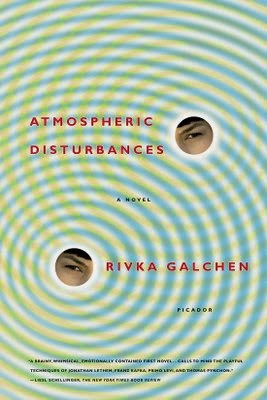 "When Dr. Leo Liebenstein´s wife disappears, she leaves behind a single confounding clue: a woman who looks, talks, and behaves exactly like her. A simulacrum. But Leo is not fooled, and he knows better than to trust his senses in matters of the heart. Certain that the real Rema is alive and in hiding, he embarks on a quixotic journey to reclaim her. With the help of his psychiatric patient Harvey—who believes himself to be a secret agent able to control the weather—his investigation leads him from the streets of New York City to the southernmost reaches of Patagonia, in search of the woman he loves. Atmospheric Disturbances is a witty, tender, and conceptually dazzling ( Booklist ) novel about the mysterious nature of human relationships."
Despite this description of a kind of girly story, and despite the list of six excellent critics (I tend to distrust a book that displays a list of nice critics), and despite one of the female critics calling it an "exquisite first novel" (I tend to distrust even more a book written by a woman and displaying a list of nice critics all written by women - which was not the case though), I opened the book and read the first lines:
Last December a woman entered my apartment who looked exactly like my wife. [This first line is already a great one, I think.] This woman casually closed the door behind her. In an oversized pale blue purse—Rema’s purse—she was carrying a russet puppy. I did not know the puppy. And the real Rema, she doesn’t greet dogs on the sidewalk, she doesn’t like dogs at all. The hayfeverishly fresh scent of Rema’s shampoo was filling the air and through that brashness I squinted at this woman, and at that small dog, acknowledging to myself only that something was extraordinarily wrong.
She, the woman, the possible dog lover, [this, "the possible dog lover", is what made me decide to buy the book] leaned down to de-shoe. Her hair obscured her face somewhat, and my migraine occluded the edges of my vision, but still, I could see: same unzipping of wrinkly boots, same taking off of same baby blue coat with jumbo charcoal buttons, same tucking behind ears of dyed cornsilk blonde hair. Same bangs cut straight across like on those dolls done up in native costumes that live their whole lives in plastic cases held up by a metal wire around the waist. Same everything, but it wasn't Rema. It was just a feeling, that's how I knew.
So, synopsis, my style:
The narrator is a 50-something years old American psychiatrist, married to a young and charming Argentine woman, who (the psychiatrist) unconvinced follows the wife´s suggestion to pretend to be a secret agent from the Royal Academy of Meteorology, for which one of his patients thinks he (the patient) is working with his special ability to control atmospheric events. This is what we get to know after reading a few pages. But the first thing we know, the central story of the novel, is that the psychiatrist´s wife has misteriously dissapeared and been impersonated by an exact replica of hers, a woman the narrator calls "the simulacrum". And, apart of the fact that he doesn´t know where she is, or even if she has left by her own will or instead she´s been taken, apart of the fact that he doesn´t know the reason of her disappearing or whether she will come back or not, what is most disturbing is the fact that nobody seems to notice the difference, not even the simulacrum herself. From his perspective of a psychiatrist, he of course acknowledges that he could be taken by a fool, but he obviously is not, and he gives us rational proof. Also, after getting a misterious call from the Royal Academy of Meteorology, which might be related to Rema´s disappearing, he starts digging and reading some papers by Tzvi Gal-Chen, the meteorologist he and Rema invented for his patient and who he is supposed to be working for, according to their fake story. And it turns out, the papers might subtly reveal some clues about Rema´s possible location:
The first author: Tzvi Gal-Chen.
The paper was originally presented at a conference in Buenos Aires.
Buenos Aires being Rema´s hometown.
And Tzvi Gal-Chen being Tzvi Gal-Chen.
And the article was about retrieval. Specifically: "Retrieval of Thermodinamic Variables Within Deep Convective Clouds: Experiments in Three Dimensions."
My pulse rose. My fingers went cold. Then the light went out; I crawled along the shelving to turn it back on. I know the ordinary often masquerades as the extraordinary, that if you put thirty people together in a room, the likelihood that two have the same birthday is over ninety percent, that when you learn a new word and it then seems suddenly ever present it is only because you have just begun to notice what was there all along. (This once happened to me with the word cathect. Also Rosicrucian.) Maybe that´s all that this find of mine was. For all I know, maybe Tzvi Gal-Chen and Buenos Aires were both already pervasive terms and I´d simply stumbled accross two examples of Baader-Meinhof phenomenon. But the fitting together of so many elements—sometimes that really happens, a stray orange peel, a necklace, and a certain joke about iceberg lettuce once converged to reveal a girlfriend´s infidelity—convinced me that I was perceiving something real, that I was not myself in any way cracked, that only my world suddenly was.
This book is, indeed, a very good first novel (I wouldn´t say exquisite, but it is good). The author herself is a doctor, so she knows her stuff, but she also talks a lot about meteorological science, which proves that she did some additional research. She uses (the psychiatrist uses) such an analytical and somewhat scientific languages that for moments you get to believe that the simulacrum is just a simulacrum, you think "ok, I know this is not possible, but what if...?"
Which takes us to the matter of the beauty of literary language.
No one would say the text in this book is beautiful, no one would call this a beautiful story. It´s a smart story with brilliant phrases and brilliant whole paragraphs written just the way the psychiatrist reasons. And yet you can tell that the words, the prases, the speech, are carefully chosen with the purpose of making it believable, enjoyable and addictive.
And here´s what I think:
I don´t think a literary work must be necessarily beautiful. I don´t think the story must serve the beauty of the language, but the language must serve the story. This is not a story that could have been written with pompous grandiloquent words.
And one of the hardest aspects of writing a novel (not that I know though) is being able to choose the language that best suits the story you´re telling.
Anyways. I really enjoyed the reading, it made me think (also about things other than the story itself), it was a very good sample of a first novel, and it made me want to read 240 pages of English.
I have to blog about several García Márquez´s, Brave new world and Animal farm (that I remember).
But I will leave those for later. Today I´m blogging about Atmospheric disturbances, by Rivka Galchen. (If you don´t like my "review", this is a link to The New York Times Book Review - And I hate American/English use of brackets; I´d never write this this way in Spanish...)
First of all, as an introduction or something like that...
I had run out of books to read, and I still had a whole week left in NY, plus the flight back to Spain... So I went to The Strand (where books are loved) with the intention to pick something in Spanish. I did - Time must have a stop, by A. Huxley, in progress - but then I saw this book on one of the desks. I had seen it many times before (it was in a very visible place - just like The lord of the flies, I´ve seen that one like 2983456 times!!) and it had never got my attention. Rather, it had, but I would just think it was probably one of those stupid pseudo-sci-fi books for nerds or for casual not very committed readers. I don´t know why that day I had an impulse to take it and read the cover:
"When Dr. Leo Liebenstein´s wife disappears, she leaves behind a single confounding clue: a woman who looks, talks, and behaves exactly like her. A simulacrum. But Leo is not fooled, and he knows better than to trust his senses in matters of the heart. Certain that the real Rema is alive and in hiding, he embarks on a quixotic journey to reclaim her. With the help of his psychiatric patient Harvey—who believes himself to be a secret agent able to control the weather—his investigation leads him from the streets of New York City to the southernmost reaches of Patagonia, in search of the woman he loves. Atmospheric Disturbances is a witty, tender, and conceptually dazzling ( Booklist ) novel about the mysterious nature of human relationships."Despite this description of a kind of girly story, and despite the list of six excellent critics (I tend to distrust a book that displays a list of nice critics), and despite one of the female critics calling it an "exquisite first novel" (I tend to distrust even more a book written by a woman and displaying a list of nice critics all written by women - which was not the case though), I opened the book and read the first lines:
Last December a woman entered my apartment who looked exactly like my wife. [This first line is already a great one, I think.] This woman casually closed the door behind her. In an oversized pale blue purse—Rema’s purse—she was carrying a russet puppy. I did not know the puppy. And the real Rema, she doesn’t greet dogs on the sidewalk, she doesn’t like dogs at all. The hayfeverishly fresh scent of Rema’s shampoo was filling the air and through that brashness I squinted at this woman, and at that small dog, acknowledging to myself only that something was extraordinarily wrong.
She, the woman, the possible dog lover, [this, "the possible dog lover", is what made me decide to buy the book] leaned down to de-shoe. Her hair obscured her face somewhat, and my migraine occluded the edges of my vision, but still, I could see: same unzipping of wrinkly boots, same taking off of same baby blue coat with jumbo charcoal buttons, same tucking behind ears of dyed cornsilk blonde hair. Same bangs cut straight across like on those dolls done up in native costumes that live their whole lives in plastic cases held up by a metal wire around the waist. Same everything, but it wasn't Rema. It was just a feeling, that's how I knew.
So, synopsis, my style:
The narrator is a 50-something years old American psychiatrist, married to a young and charming Argentine woman, who (the psychiatrist) unconvinced follows the wife´s suggestion to pretend to be a secret agent from the Royal Academy of Meteorology, for which one of his patients thinks he (the patient) is working with his special ability to control atmospheric events. This is what we get to know after reading a few pages. But the first thing we know, the central story of the novel, is that the psychiatrist´s wife has misteriously dissapeared and been impersonated by an exact replica of hers, a woman the narrator calls "the simulacrum". And, apart of the fact that he doesn´t know where she is, or even if she has left by her own will or instead she´s been taken, apart of the fact that he doesn´t know the reason of her disappearing or whether she will come back or not, what is most disturbing is the fact that nobody seems to notice the difference, not even the simulacrum herself. From his perspective of a psychiatrist, he of course acknowledges that he could be taken by a fool, but he obviously is not, and he gives us rational proof. Also, after getting a misterious call from the Royal Academy of Meteorology, which might be related to Rema´s disappearing, he starts digging and reading some papers by Tzvi Gal-Chen, the meteorologist he and Rema invented for his patient and who he is supposed to be working for, according to their fake story. And it turns out, the papers might subtly reveal some clues about Rema´s possible location:
The first author: Tzvi Gal-Chen.
The paper was originally presented at a conference in Buenos Aires.
Buenos Aires being Rema´s hometown.
And Tzvi Gal-Chen being Tzvi Gal-Chen.
And the article was about retrieval. Specifically: "Retrieval of Thermodinamic Variables Within Deep Convective Clouds: Experiments in Three Dimensions."
My pulse rose. My fingers went cold. Then the light went out; I crawled along the shelving to turn it back on. I know the ordinary often masquerades as the extraordinary, that if you put thirty people together in a room, the likelihood that two have the same birthday is over ninety percent, that when you learn a new word and it then seems suddenly ever present it is only because you have just begun to notice what was there all along. (This once happened to me with the word cathect. Also Rosicrucian.) Maybe that´s all that this find of mine was. For all I know, maybe Tzvi Gal-Chen and Buenos Aires were both already pervasive terms and I´d simply stumbled accross two examples of Baader-Meinhof phenomenon. But the fitting together of so many elements—sometimes that really happens, a stray orange peel, a necklace, and a certain joke about iceberg lettuce once converged to reveal a girlfriend´s infidelity—convinced me that I was perceiving something real, that I was not myself in any way cracked, that only my world suddenly was.
This book is, indeed, a very good first novel (I wouldn´t say exquisite, but it is good). The author herself is a doctor, so she knows her stuff, but she also talks a lot about meteorological science, which proves that she did some additional research. She uses (the psychiatrist uses) such an analytical and somewhat scientific languages that for moments you get to believe that the simulacrum is just a simulacrum, you think "ok, I know this is not possible, but what if...?"
Which takes us to the matter of the beauty of literary language.
No one would say the text in this book is beautiful, no one would call this a beautiful story. It´s a smart story with brilliant phrases and brilliant whole paragraphs written just the way the psychiatrist reasons. And yet you can tell that the words, the prases, the speech, are carefully chosen with the purpose of making it believable, enjoyable and addictive.
And here´s what I think:
I don´t think a literary work must be necessarily beautiful. I don´t think the story must serve the beauty of the language, but the language must serve the story. This is not a story that could have been written with pompous grandiloquent words.
And one of the hardest aspects of writing a novel (not that I know though) is being able to choose the language that best suits the story you´re telling.
Anyways. I really enjoyed the reading, it made me think (also about things other than the story itself), it was a very good sample of a first novel, and it made me want to read 240 pages of English.
martes, 3 de junio de 2014
Abdication
I was working on a post about the last book I read, but recent events made me publish this first, that we need to discuss with some perspective.
So... our king.
This man that we the youth remember mostly for his superboring new year speeches, his lung surgery for something that was "not cancer", his famous "why don´t you shut up" to Hugo Chaves, his safari to Botswana defraid with our money to hunt some elephants and get his hip broken. We also know his family quite well: his son, the prince, who was finally weaned when he married the news anchor; his eldest daughter, who got married to a count who loved spirits (and eventually got divorced); his second daughter, who got married to a former Spanish handballer and gave the royal family an even worse name "not knowing what she was signing". His wife, always correct and composed while he is said to be fucking around and having more bastards than Robert Baratheon. This is what we have seen.
For older people though, this is the man who took Spain out of Franco´s régimen, who released a bunch of political prisoners, who got a coup d´état aborted in 1981 (known as 23F), who defended the Spanish constitution.
I think he deserves respect for all he did in the past, and I also think he deserves negative respect for all he´s been doing in the last few years.
And I think we got tired of a monarchy, especially when the royal family is involved in scandal and financial fraud. But even if it was not, the idea of a political system where the designation of the ultimate authority is based on a birth right sounds absurd to me, no matter how good or bad this authority might turn out to be. And we got mad at these people who not only waste our money for hunting elephants, but also defraud and are not punished (yet; we´ll see).
So... if the other option is a democratic republic... let´s give it a try! Let´s call for referendum to see what the people want. And then, at least, whatever the result, we will have the satisfaction to be given the oportunity to opine.
And maybe Felipe will be elected as the president of the III Spanish republic...

PD- I wouldn´t really define myself as a republican. I just think monarchy sucks.
So... our king.
This man that we the youth remember mostly for his superboring new year speeches, his lung surgery for something that was "not cancer", his famous "why don´t you shut up" to Hugo Chaves, his safari to Botswana defraid with our money to hunt some elephants and get his hip broken. We also know his family quite well: his son, the prince, who was finally weaned when he married the news anchor; his eldest daughter, who got married to a count who loved spirits (and eventually got divorced); his second daughter, who got married to a former Spanish handballer and gave the royal family an even worse name "not knowing what she was signing". His wife, always correct and composed while he is said to be fucking around and having more bastards than Robert Baratheon. This is what we have seen.
For older people though, this is the man who took Spain out of Franco´s régimen, who released a bunch of political prisoners, who got a coup d´état aborted in 1981 (known as 23F), who defended the Spanish constitution.
I think he deserves respect for all he did in the past, and I also think he deserves negative respect for all he´s been doing in the last few years.
And I think we got tired of a monarchy, especially when the royal family is involved in scandal and financial fraud. But even if it was not, the idea of a political system where the designation of the ultimate authority is based on a birth right sounds absurd to me, no matter how good or bad this authority might turn out to be. And we got mad at these people who not only waste our money for hunting elephants, but also defraud and are not punished (yet; we´ll see).
So... if the other option is a democratic republic... let´s give it a try! Let´s call for referendum to see what the people want. And then, at least, whatever the result, we will have the satisfaction to be given the oportunity to opine.
And maybe Felipe will be elected as the president of the III Spanish republic...
PD- I wouldn´t really define myself as a republican. I just think monarchy sucks.
martes, 6 de mayo de 2014
Life is a bitch
I was gonna
start this entry saying that I would talk about something I had never thought
of before, but that´s not true. So I will start pointing out how it´s funny
that sometimes one suddenly finds oneself translating a vague intuition into a
clear and well structured thought, if such thing even exists. And it´s funny
how that happens at the most unrelated moment, for example, while you´re
washing the salad bowl.
In
synthesis, my thought was: “Life is a bitch”. A bit better developed, it was:
“Life is one and only one, and you never get anything for free”.
Let´s start
with “Life is one and only one”. Yes, it´s rather obvious but, like I said, I
had never actually thought of this as part of a proper thought. Life is one and
only one, and there´s no turning back. What you do, gets done; and what you
don´t do, will unavoidably remain undone forever and ever in the CV of your
life.
And here it
comes the second part, “You never get anything for free”. Life is nothing but a
succession of decisions and consequences. Some decisions are not too important,
and their consequences are not final. As kids, the training is not too hard,
and it´s always kind of easy to distinguish the right from the wrong decision:
good vs bad, I like this vs I don´t like this, you´re my friend vs you´re not
my friend… The right choice will have good consequences and the wrong one will
have bad consequences, which you can anticipate. But as we grow older, it
becomes more frequent this kind of situation when you have to choose between two
options which are restrictive, either this or that, and which you know will
have both good and bad consequences that will change your lifeline forever in
whatever direction: leave vs stay, commitment vs no commitment, one job vs
another job (lucky you if this is your case btw), kids vs no kids, now vs not
yet, push vs let go, try harder vs this is not worth any more of my time and
effort…
Let´s take
the first example: If you leave, that´s great. The CV of your life will say:
“This person left”. This person saw this opportunity and took it. Cool. But it
will also say: “This person didn´t stay”. This person saw this opportunity and
decided to give up some other great things he/she already had.
If you
stay: “This person saw this opportunity and decided that it wasn´t worth to
give up the great things he already had here”, but “This person missed this
opportunity because he wasn´t courageous enough to give up other great things
he already had”.
Commitment,
yes: “This person made this commitment that led to this and this and this great
things”, or “This person lost this and this and this great opportunities because
of this commitment he had made at this point of his lifeline”.
Commitment,
no: “This person didn´t make this commitment, which let him be available for
this and this and this other great opportunities”, or “This person didn´t make
this commitment and lost this chance forever”.
And so on.
Kurt
Vonnegut said: 'The truth is, we know so little about
life, we don't really know what the good news is and what the bad news is.'
[Let´s be
honest, I haven´t read anything by him yet. I stumbled on this quote only by chance]
And that’s the
thing, right? You will never know whether you made the right or the bad
decision, because there´s no way to compare what did happen next versus what
could have possibly happened, had you taken the other path. Which, btw, didn´t
necessarily go in the opposite direction, but in one of the many other possible
directions. Kind of like this:

If you
decide to take one path, at the same time you´re deciding not to take any of
the others. Because life is a bitch, life is one and only one, and you never
get anything for free. With every decision you make, you are sacrificing the
good consequences that could have derived from the decisions you didn´t make.
So I guess,
at this point of our lifes, my friend, a good approach would be, not to try to
identify what we want (because that´s almost impossible, at least in my case… I
want a lot of things that are restrictive among them), but to identify, above
all the possible choices, what we don´t want to regret. That way, at least, we
can comfort ourselves: “Ok, this turned out not to be what I expected, but at
least now I know it”.
If anyone
has some consolation words for me, THIS is the moment.
sábado, 26 de abril de 2014
Trigger
Llevaba yo toda la tarde con un nudo en la garganta, y ha sido ver este vídeo y no poder parar...
miércoles, 23 de abril de 2014
I posted about the death of Garcia Marquez but this post is about Saramago
First of all, I have to say I did write something on the death of Gabriel Garcia Marquez, only in this other blog that I recently started.
But there's this post I'm delaying because I don't want to be the one who writes it, but I do want to write about my last conquests by José Saramago.
In my vast ignorance about non-Spanish literature (which I'm trying to fix) I didn't know about him until after I finished university. For some reason I don't remember, probably related to some stupid paperwork I had to do before taking my MIR exam, back in 2008, I was on my way to the university and from the bus I saw one of those huge posters by the road, showing a photo of the author and some novel I don´t remember. Because I had decided not to study for the exam, and because I was feeling so guilty about that and I needed something to fill all that sudden "free time", I did some little (tiny) research and went to the library with the intention of picking The gospel according to Jesus Christ. They didn't have that one and, when I was trying to take All the names, another book felt down (Homecoming -Die Heimkehr-, by Bernhard Schlink - review here) and I thought, why not? Well, to be honest, I thought this is a sign! and picked that one instead... Didn't happen to be the wrong choice until the last 50 pages or so, when the author had a personality crisis or something and the story turns into a completely different one, but whatever.
So... Back to Saramago, since then, I had always wanted to read something by him, and I won't say I never had the time because I did, but it was like one of those things you vaguely want to do but never actually do..., until the first time I came to the U.S. with James Joyce's Odyssey in my backpack and it turned out not to be the most productive reading for me, at least at that point of my existence.
So, the first novel I read by Saramago was Blindness (Ensaio sobre a Cegueira - "Essay on blindness" in English), which I downloaded in pdf for free while in NY, muahahaha.
In this novel, he tells a story that happens who knows where, when the citizens suddenly start to get blind inexplicably. Of course panic spreads, because nobody knows how this "white blindness" is transmitted.
If you're not used to his style (I wasn't yet) and maybe also even if you are, you might find it not easy to read. You'll see, he uses these kilometric sentences that sometimes are so long that they don´t fit in one page. He never uses full stops but you'll have a lot of commas to separate narration from dialogues. You'll know when a dialogue starts when you see a capital letter following a comma, and you'll know that there's someone else speaking when you see another capital letter following another comma, and so on. Also, he never uses proper nouns in this novel, so the characters are "the first blind guy", "the doctor", "the doctor's wife", "the girl with the dark glasses" and such.
After that one, I read The Elephant´s Journey (A Viagem do Elefante) (haven´t finished it yet, because I´m reading it in english and I´m lazy), Cain (Caím) and Death with Interruptions (As Intermitências da Morte).
Cain is my favourite so far, but I´m gonna let someone else blog about it (hopefully, some day).
I´m just gonna try to explain why I think his style works so well, to me at least.
Will give you as an example the beginning of The Elephant´s Journey (sorry for the length):
Strange though it may seem to anyone unaware of the importance of the marital bed in the efficient workings of public administration, regardless of whether that bed has been blessed by church or state or no one at all, the first step of an elephant’s extraordinary journey to austria, which we propose to describe hereafter, took place in the royal apartments of the portuguese court, more or less at bedtime. And it is no mere accident that we chose to use the vague expression more or less. For this enables us, with admirable elegance, to avoid having to go into details of a physical and physiological nature, often sordid and almost always ridiculous, and which, set down on paper, would offend the strict catholicism of dom joão the third, king of portugal and of the algarves, and of dona catarina of austria, his wife and the future grandmother of the same dom sebastião who will go off to lead the attack on alcácer-quibir and die there during the first assault, or perhaps the second, although there are also those who say he died of an illness on the eve of battle. This is what the king, with furrowed brow, said to the queen, I’m worried about something, my lady, About what, my lord, The gift we gave to our cousin maximilian at the time of his marriage four years ago always seemed to me unworthy of his lineage and his merits, and now that we have him close to home, so to speak, in his role as regent of spain in the city of valladolid, I would like to offer him something more valuable, more striking, what do you think, my lady, A monstrance would be a good idea, my lord, a monstrance, I find, is always most welcome, perhaps because it has the virtue of combining material value and spiritual significance, Our holy church would not appreciate such liberality, it doubtless still retains in its infallible memory cousin maximilian’s confessed sympathies for the reforms of the lutheran protestants, or were they calvinists, I was never quite sure, Vade retro, satana, exclaimed the queen, crossing herself, such a thought had never even occurred to me, now I’ll have to go to confession first thing in the morning, Why tomorrow in particular, my lady, given that it is your custom to go to confession every day, asked the king, Because of the vile idea that the enemy placed on my vocal cords, oh, I can feel my throat burning as if it had been scorched by a breath from hell itself. Accustomed to the queen’s sensory excesses, the king shrugged and returned to the difficult task of finding a present that might satisfy archduke maximilian of austria. The queen was murmuring a prayer and had just begun another when, suddenly, she stopped and almost shouted out, There’s always solomon, What, asked the king, perplexed by this untimely invocation of the king of judah, Yes, my lord, solomon the elephant, And what has the elephant got to do with anything, asked the king somewhat waspishly, He could be the gift, my lord, answered the queen, standing up, euphoric and very excited, He’s not exactly an appropriate wedding present, That doesn’t matter. The king nodded slowly three times, paused and then nodded another three times, after which he said, Yes, it’s an interesting idea, It’s more than interesting, it’s a very good idea, an excellent idea, retorted the queen, unable to suppress a gesture of impatience, almost of insubordination, the creature came from india more than two years ago, and since then he’s done nothing but eat and sleep, with his water trough always full and a constant supply of food, it’s as if he were a kept beast, but one who’ll never earn his keep, That’s hardly the poor creature’s fault, there’s no suitable work for him here, unless we were to send him to the docks on the river tagus to transport planks, but the poor thing would only suffer, because his professional specialty is transporting felled trees, so much better suited to the curve of his trunk, Send him off to vienna, then, But how, asked the king, That’s not our affair, once cousin maximilian is the owner, it will be a matter for him to resolve, he is, I assume, still in valladolid, As far as I know, yes, Obviously, solomon would have to travel to valladolid on foot, he has the legs for it after all, And then on to vienna as well, he’ll have no alternative, It’s a long way, said the queen, A very long way, agreed the king gravely, and added, I’ll write to cousin maximilian tomorrow, and if he accepts, we’ll have to agree on dates and ascertain certain facts, for example, when he intends leaving for vienna, and how many days it would take for solomon to travel from lisbon to valladolid, after that, it’s up to him, we wash our hands of the affair, Yes, we wash our hands, said the queen, but deep inside, which is where the contradictions of the self do battle, she felt a sudden sadness at the thought of sending solomon off to such distant lands and into the care of strangers.
(Here to read the whole first chapter)
Yes, if you see this mass (or this mess) of words without full stops, without paragraphs, you might not feel very inclined to read it (did you read it? Right, that´s what I mean). It looks like there´s no pause for breathing until the end. And it looks like you will never be able to get to the end, or even to the third or fourth page... But once you start reading it, he gets you so interested in the story that you will not even notice the lack of conventional punctuation. Rather, you will notice it, and you´ll see how naturally the story develops.
To me, during the parts where the narrator is speaking, it's like he's trying to recreate the way he would tell the story if he was telling it out-loud to a friend (i.e. you), whereas for the parts where there's dialogue, he tries to emulate the scene, to set you in the very room where the characters are, so that you're not just listening to a narration but actually witnessing the action. And, in order to do this, he gets rid of those artificial elements of written language that don't have a translation or an equivalent in spoken language, such as the dashes in dialogues or the capital letter in proper names (when he uses them).
This way, contrary to what it may seem if you just limit yourself to take a superficial look at the bunch of lines, and lines, and lines, page after page without a breathing pause, the story goes on fluently without being constantly interrupted, artificially, by things like:
- Blah blah blah - the King said.
- Blah blah blah blah - the Queen replied.
- Blah blah? - he asked her.
- Blah blah - she stated.
No, you don't need all that "the King said", "the Queen replied"..., you don't need him to tell you that, because you're seeing it as it happens, first-hand.
Another characteristic of Saramago that I've noticed, I think, in all the four novels I've read by him, is the fact that, as a narrator, he (or they, because he always refers to himself in plural as if he was a part of some group) is somehow above the story, he's better than the characters and he takes the liberty to judge or criticize them or to make comments completely outside the story.
But not only he is a great story teller, he's also a great story maker. I told you about Blindness. If you haven´t read it, you might think it´s a stupid story: people getting blind by some sort of magic. Great. And I haven´t told you about Death with Interruptions yet, but here I go: once upon a time in the present time, this woman named Death quits her job and people stop dying. Also, great. Both of them sound like the kind of stupid stories that I, grown up and busy adult, don´t want to waste my time with.
Yes. The facts that originate the stories are absurd. What happens next is rather comic. The way he tells it is quite satirical. But what is great about it is that, if you think of it, this might actually be the reaction of people if they did suddenly get blind, if they did suddenly stop dying. And because, given the absurd circumstances that trigger the story, that might actually be the reaction in reality, he has the justification to be satirically critic towards society and its strata. With special attention to clergy!
Funny thing, in Death with Interruptions, written in 2005, he states something that anticipates the fact that origins the whole Cain pilgrimage in Cain, written in 2009:
It´s easy enough to understand, it takes very little imagination to see why death´s workplace is probably the dullest of all those created since cain killed abel, an incident for which god bears all the blame.
About this particular book though, I'll probably post something in detail sooner or later (later, I guess, let's be honest). Because, although overall I liked it, I got kind of disappointed...
But anyways, this "anticipation" business made me realize, because I had recently read Garcia Marquez's No one writes to the colonel and noticed the same thing (read this post about it), that, the same way some readers read several books at the same time, also some authors write several novels at the same time. Yes, I know it's ridiculously obvious, but I had never thought of that before! And I discovered that I enjoy crossed references between them when I'm able to identify them. Rather, I enjoy being able to identify crossed references between them...
I think this is it for now. I hope it's not me the one who posts about Cain (wink-wink).
I already have several other books to post about: Brave new world, Strange pilgrims and Animal Farm, which I'm reading right now.
I have to say, I hate when they don't translate the title of the books accurately!!
The Spanish name for Brave new world is Un mundo feliz (A happy world).
The English name for Ensaio sobre a Cegueira is Blindness.
The English name for Memoria de mis putas tristes (Memory of my sad whores) is Memories of my melancholic whores.
The English name for Doce cuentos peregrinos (Twelve pilgrim tales) is Strange pilgrims.
Why??!
Suscribirse a:
Entradas (Atom)